
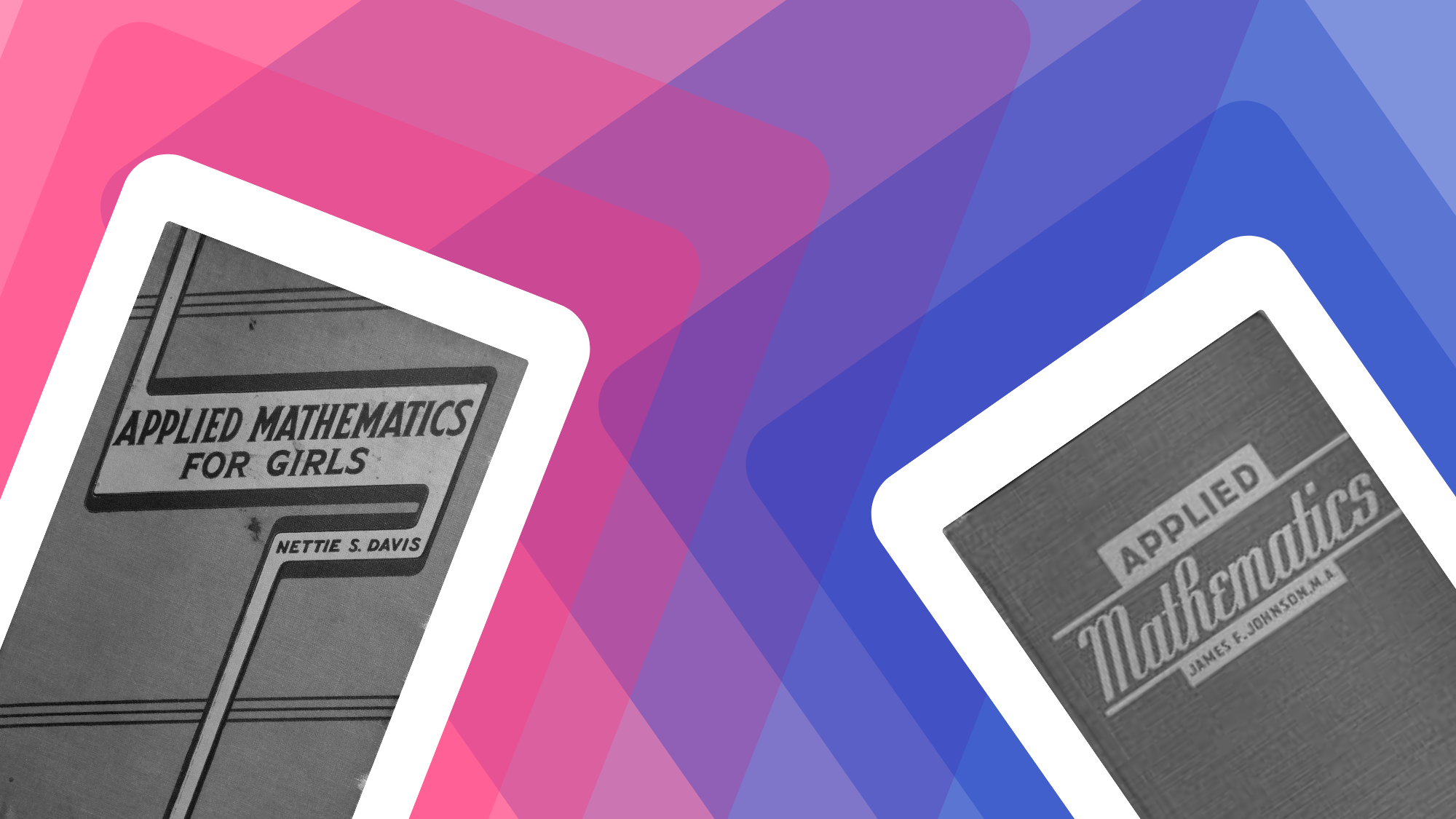
Applied Mathematics for Girls… I don’t know about you, but even that title just sets my alarm bells ringing. What on earth could a maths textbook for girls offer you that a textbook for boys cannot?
In the age of “girl math” memes and co-ed schooling, it’s easy to forget that access to equitable education for women in mathematics is still a relatively recent concept. In fact, looking back a hundred years or so, you see just how far we’ve come. And boy, oh boy, does Nettie Davis Stewart’s textbook highlight that.
Applied Mathematics for Girls is a textbook written in 1940, designed to instil in young women basic mathematical skills that they could then apply to their work and/or role in the home. This book assumes the reader has very little foundational mathematical knowledge and focuses only on the basics of maths, leaving very little room for passion and curiosity to grow.
Half of the book is spent like any other textbook, building up mathematical skills through lessons and exercises. Very basic mathematical skills, but mathematical skills nonetheless. It covers topics such as arithmetic, fractions, decimals, geometry and more. What seems fine at first, however, becomes a little more concerning as you read on. After learning each new technique, students are then asked to apply their knowledge to increasingly gendered scenarios, ranging from buying fabric for a dress to estimating the price of a home-cooked meal.
Even worse, the rest of the book is then spent on what is essentially home economics in a mathematics-shaped costume. It’s almost funny, really. I mean, who would expect a maths textbook to have a section on “ruffling problems” or multiple pages on how to decorate a lampshade? While the book approaches these concepts through a mathematical lens, it is clear that the emphasis is really on teaching women the heavily gendered skills that were required at the time. From counting calories to balancing timecards, the scope of women’s mathematical ability is funnelled down into being a wife or secretary. A fact deeply layered in irony, as at the time, women were being called up to replace male engineers and mathematicians because of the Second World War.
It is worth noting that there was a male equivalent of this book, Applied Mathematics, released one year prior, which was also quite gendered in its content. It swaps out sewing for carpentry and cooking for mechanics, but is equally limited in its scope. The key difference, however, between the approaches of these books is that while Applied Mathematics is marketed towards men in trade school, Applied Mathematics for Girls was written for all secondary school girls, regardless of their career aspirations.
Beyond the blatant stuff, there’s also a more subtle undercurrent of misogyny that runs throughout the book. From Betty, who spends 45% of her ‘leisure time’ looking after children, to Margaret, who must sacrifice two-thirds of her paycheck to her parents every week, the women in these exercises aren’t exactly thriving. Despite being fictional, it is always the men making large purchases, earning a commission and paying taxes in the practice questions, while the women tend to spend their time buying fur coats and stockings.
Now, I will say, it’s not all negative. There are some chapters of the book which go into pretty impressive detail on taxes, insurance and banking. There’s even a fairly robust section on tariffs, which I think a few people today could do with reading. While these concepts seem fairly accessible in today’s climate, this kind of knowledge would have been life-changing for some back when this book was published. To have financial freedom, in the form of education, is so important, particularly in a time when women were often expected to rely on men to live.
While I will not be recommending this book to anyone (I mean, what kind of crazy person signs up to voluntarily read a textbook?!), it does raise some interesting questions on how we encourage women in STEM. There is, of course, merit to appealing to their interests and strengths, but I think this book really highlights just how careful we need to be not to fall into stereotypes and take it too far. Otherwise, we risk pigeonholing women in the very ideals we are trying to help them escape from.
Leave a Reply